
Nous utilisons des cookies!
Les cookies sont des fichiers témoins que nous utilisons pour mieux comprendre le comportement des visiteurs. Les données recuillies nous aident à améliorer l'expérience utilisateur de notre site web.
C’est une entreprise québécoise qui est spécialisée dans l’exploitation et la transformation d’ardoise canadienne.
Notre intégration verticale, l'utilisaton de notre gamme d’outils de coupes de haute technologie (CNC, ponts de coupes de 18 lames, planeur à pierre, etc.), notre variété de couleurs, alliés à plus de 25 années de connaissance et d’expérience dans cette pierre naturelle, positionne l’Ardoisière comme le leader dans ce marché.
L’entreprise vous propose via sa vaste gamme de produits, une ardoise de haute qualité qui saura répondre à vos besoins. Que ce soit pour un recouvrement mural, un revêtement de plancher, un comptoir de cuisine, une mosaîque, un recouvrement de douche, un parement de foyer, que votre projet soit intérieur, extérieur ou de l’aménagement paysager, notre ardoise et notre expérience sont reconnues pour répondre à vos besoins.
Et si vous effectuez la pose vous-même, l’entreprise peut vous offrir des outils facilitant ce travail, des séminaires vidéo et même des plans de pose pour certains produits.
À l’Ardoisière peu importe le produit choisi, ils ont tous été conçus en fonction que votre projet se réalise aisément.
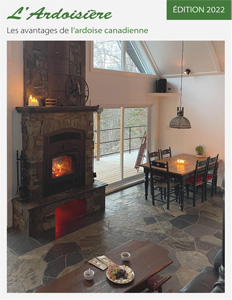
En savoir plus sur l'ardoise Posez une question à nos expertsRedécouvrez les avantages de l'ardoise canadienne dans notre guide d'inspiration. L'ardoise canadienne, un produit local et durable, pour tous vos projets de construction et de rénovation haut de gamme. Laissez-vous inspirer par notre guide avec des exemples de réalisations pour toutes les pièces de la maison, ainsi qu'à l'extérieur.
Qu’est-ce qui fait que l’ardoise canadienne est un bon produit pour une application extérieure?
Un bref retour dans l’histoire géographique de l’ère Carbonifère, nous rappellera que le plateau Nord Américain était relié au continent Européen par la Pangée. Aujourd’hui cette "connexion" est toujours présente par le fait que notre schiste localisé en Nouvelle- Écosse est le même que nous retrouvions dans le nord de l’Europe. Un schiste d’ardoise très dense reconnu en France pour sa durabilité et ses applications extérieures pour des toîtures, des murets, du dallage, etc.
Les principales caractéristiques de cette ardoise sont: elle est très peu poreuse, il y a absence de pyrite et d’oxyde ferreux, elle n'est pas affectée par les contaminants externes et elle est non friable, donc l’application de scellant n’est pas nécessaire.
Parmi les produits extérieurs que l’Ardoisière offre, il y a le galet d’ardoise (qui se veut un remplacement au paillis de cèdre), les pas de jardins et les pierres pour muret. Notez aussi que tous les autres produits dans leurs gammes distinctes sont applicables à l’extérieur. Certaines recommandations sont à respecter.
Galet d'ardoise Pas de jardinComme l’ardoise est entièrement naturelle, chaque pierre aura son propre cachet de par sa nuance de couleur et son relief unique. Pour le recouvrement mural ou un parement de foyer, une multitude de possibilités s’offrent à vous. Vous pouvez utiliser des formes naturelles ou pré-usinées, présentant un style rustique, champêtre ou contemporain, et même exploiter votre côté artistique dans sa composition.
Pour vous faciliter la tâche nous avons une gamme de produits à proposer et il y a toujours la possibilité d’examiner avec vous la personnalisation de votre produit.
Les revêtements murauxTraversant les époques et les modes, toujours actuelles au niveau de la décoration, l’ardoise canadienne demeurera toujours une valeur ajoutée. Sa haute densité, sa non contamination, sa résistance aux piétinements intenses et son absence d’utilisation de scellant en font toujours sa figure de proue en produit de revêtement de plancher.
La gamme de produits planchers offerte est toujours en référence avec les styles recherchés. Pour un aspect rustique le produit vrac conviendra parfaitement. Dans un environnement champêtre au goût du jour, la version 2.0 du vrac, le Terra-Nova, répondra à cette attente. Il s’agit d’une version où la forme des pierres a été pré-usinée. Cet agencement s’installe aisément à l'aide d'un plan fourni. Et si l’environnement est plus contemporain les produits Terra-Lame (il s’agit de planches d’ardoise à bouts naturels ou coupés, ayant des largeurs prédéterminées et de longueurs variables) et Terra-Tuile (un jeu de 5 tuiles qui s’imbriquent les unes dans les autres) seront à considérer.
En complément, une mosaïque peu facilement s'inserer dans le plan de votre projet.
Les recouvrements de planchersNaturellement antidérapante et de très haute densité l'ardoise canadienne est le revêtement idéal pour un escalier unique. Qu'il y ait un trafic léger ou intense et même des chiens, nul besoin de sabler pour retrouver l'éclat originel comme l'exigent les escaliers de bois. Nous pouvons manufacturer vos marches, intérieures ou extérieures, sur mesure en usine. Marches, contremarches, limon… tout est possible.
Les escaliers en ardoiseLes comptoirs et îlots central, s'apparentent davantage à une œuvre d'art qu'à un objet utilitaire. L'ardoise canadienne est tout indiquée pour les comptoirs de cuisine ou de salle de bain. Moins poreuse que le granite ou le marbre, elle ne réagit pas aux acides et elle est résistante à la chaleur. Nous soulignons ici sa facilité de nettoyage.
Le client est invité à venir choisir sa plaque parmi notre inventaire. Par cette même occasion, nous pourrons discuter des choix de textures, de finissions, d’épaisseurs, et de couleurs (il faut se souvenir que nous parlons ici de veinage de couleurs, donc chaque dalle est unique, d’où l’importance de la présence du client).
Historiquement, avant que les comptoirs en aluminium soient disponibles, les comptoirs dans les laboratoires de chimie étaient fait en ardoise. Il s'agit donc d'un matériau qui a déja fait ses preuves. Sa résistance aux chocs et aux températures extrêmes a donc longuement été mise à l'épreuve.
Les comptoirs en ardoiseReconnue pour ses nombreuses propriétés, sa haute densité, sa non-porosité, sa non-friabilité et sa facilité d’entretien, l'ardoise canadienne conserve sa valeur ajoutée à travers le temps. On comprend donc pourquoi cette pierre naturelle est très prisée par les professionnels tels les architectes, designers et les connaisseurs.
Il est documenté que l'ardoise en provenance de l’Asie (principalement d'Inde et de Chine) contient de la pyrite et des oxydes ferreux. Sensibles aux contaminants tels que l’eau, le sel, les graisses, la chaleur, etc., il en résulte, une usure prématurée, un effritement à court terme, et nécessite une application régulière de scellant.
Quant à l’ardoise du Brésil, outre sa couleur mate, monochrome et son grain plus prononcé elle est également sensible aux contaminants. Une application d’un scellant s’avère nécessaire.
Pour en savoir plus sur l’ardoise CanadienneÉcrivez-nous afin de discuter de votre projet avec un membre de notre équipe.
Parlez avec nos experts!


